

Today’s book is just one of 17 in my tower, but thoughts on the 16 others may be a while coming…having done far too much typing lately at my day job, I’m going to take a long break to try to heal my aching arm (rarely have I looked forward to a PT visit this much). See you sometime in January 2026—meanwhile, happy new year!
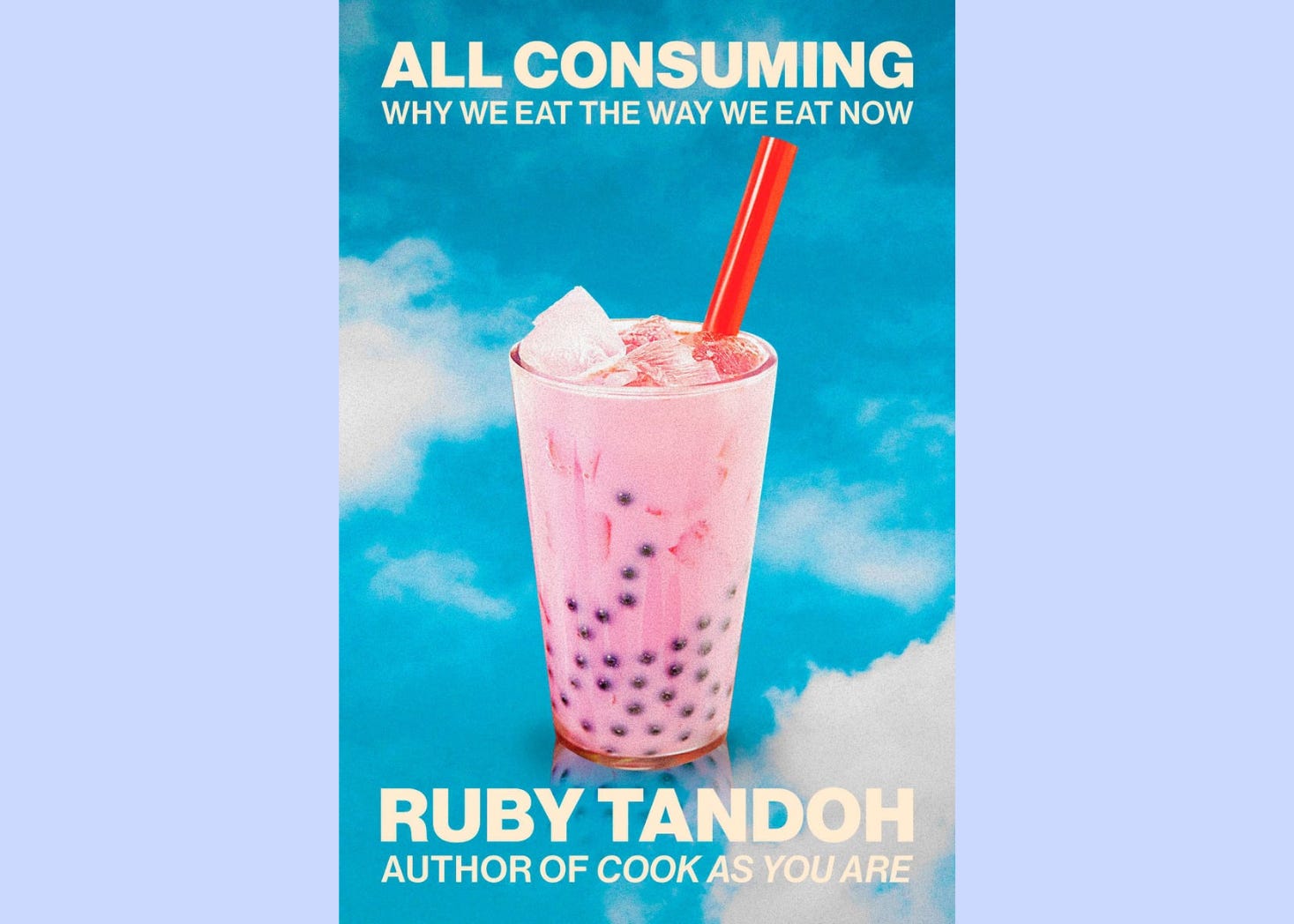
All Consuming: Why We Eat the Way We Eat Now, by Ruby Tandoh
How many of these do you have in your pantry? Preserved lemon, cumin, za’atar, sumac, gochujang, sriracha, Aleppo pepper, dates, rose harissa, hot honey, whipped feta…and do you really know how they got there?
With a light touch, Great British Bake Off finalist Ruby Tandoh takes readers of All Consuming on a tour of obvious and hidden forces that influence your next move when you step into your kitchen. She looks at how, over the past 75 years, we talk and think about food—from food influencers (ugh) to “content creators” (ugh ugh) to magic wellness drinks (ugh ugh are you kidding me), with a hefty dose of manipulation from supermarkets, TV, hype restaurants, and others with all levels of expertise.
Having fallen in love with cookbooks at a young age, I was most drawn to Tandoh’s deep look at them and at recipe creation generally.
“Craveable, suckerpunch recipes”—in a year-plus of returning to cookbook reviewing, I’ve not seen a better description of what authors seem compelled to write now. Sometimes it’s fun, inspiring, and deeply delicious. Sometimes, it’s just exhausting.
No longer, Tandoh writes, can a recipe promise to be simply practical, possible, or authentic. Instead, it must be the thing that “will make you see God.” And apparently we see God in a lot of words that end in y—creamy, dreamy, lemony, buttery, crunchy, chewy, crispy.
But the reality is that much of the time, cooks read new recipes, get excited about a new-to-them ingredient, and then return to their old favorites, maybe with a dash of one of the trendy ingredients thrown in.
And while I know many, if not most, readers will just read recipes far more than they’ll ever make them, I approach each review with the assumption that the author genuinely wants you to cook each recipe. But with so many of the new books I peruse (most of which I don’t write about, or give scant space to), I come away deeply skeptical that indeed, that was the intention—a feeling Tandoh reinforces.
And then there’s social media’s insidious influence on cookbooks, how we eat, and food photography, and how it eats away at your brain. She notes that as the landscape shifted from the explosion of blogs to hyping the latest food fad on Instagram, “you shared a photo of the food with an explanatory caption, rather than a blog post about the food with an illustrative photo. This allowed you to bypass thinking altogether and just look: burgers, hotdogs, fries, pizza, ice cream, cake, bubble tea—all those foods that instantly register as delicious.”
When I shifted away from food writing many years ago as I struggled with the point of writing new recipes—for sure, it was fun, but it was hardly living up to my expectations that my work would somehow contribute to making the world a better, safer, kinder, or more equitable place—I still viewed guiding people to be better cooks as valuable.
But with so many eyeballs glazing over now on food ridiculousness by people like Nara Smith, to whom Tandoh devotes several pages, it’s no surprise that even Tandoh confesses that she has lost almost all curiosity about cooking, and that she, a cookbook author, has caught cookbook fatigue.
There’s much more here, including chapters on the “ice cream age,” on the fast-food burger bar Wimpy in Britain (which fascinated me on a trip to England when I was 9), and on the very different restaurant travel guides written by Duncan Hines and Victor Hugo Green beginning in 1936. She sets us straight on some origin stories (no, Elizabeth David didn’t transform British cooking—though she did transform British cookbooks by sparking the notion that “a cookbook can, and even should, be a work of fantasy”), and lays a good bit of credit/blame at the feet of Yotam Ottolenghi, where “cooking is modular and iterative.”
All Consuming will consume readers’ time and provoke their thinking—in this case, just as intended.
Disclosure: I am an affiliate of Bookshop.org, which supports independent booksellers, and I will earn a commission if you click through and make a purchase on any of the titles above.